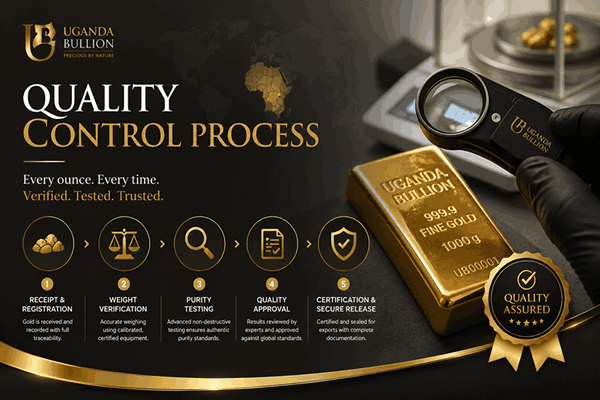
Quality Control Process for Gold Export and Trading
At Uganda Bullion, quality control is not something that happens at the end of a transaction — it runs through every stage of it. Gold buyers, investors, refiners, and international traders all need accurate testing, transparent verification, and thorough compliance procedures in place before committing to a precious metals purchase. A well-structured quality control process is what gives everyone involved the assurance that each gold shipment meets agreed specifications, confirmed purity standards, and all applicable export requirements — protecting both buyers and sellers from start to finish.
The global gold trade is built on trust, accuracy, and consistency — and even small discrepancies in purity, weight, or documentation can have real financial and legal consequences. That is why Uganda Bullion follows a comprehensive, stage-by-stage quality control process covering everything from sourcing and verification through assay testing, documentation review, secure handling, and final export preparation.
Why Quality Control Matters in Gold Trading
Gold is a high-value commodity traded across international borders, and buyers have every right to expect that what arrives matches what was agreed in contracts, assay reports, and export documentation. Quality control is what closes the gap between expectation and reality — systematically confirming that all materials meet the required standard before any shipment moves.
Effective quality control helps to:
- Confirm gold purity and authenticity.
- Prevent fraud and misrepresentation.
- Ensure compliance with export regulations.
- Protect investors and international buyers.
- Support smooth customs clearance.
- Maintain long-term business relationships.
- Enhance transparency throughout the supply chain.
Step 1: Source Verification
Quality control begins before the gold is ever handled — it starts with verifying where it came from. Responsible sourcing is the foundation of compliance with both local and international regulations, and no transaction moves forward until supplier information has been reviewed and all supporting documentation has been carefully examined.
This stage may include:
- Supplier background checks.
- Business registration verification.
- Mining or sourcing documentation review.
- Compliance screening.
- Know Your Customer (KYC) verification.
Source verification establishes legitimacy from the outset and builds a transparent, documented chain of custody that follows the gold all the way from its point of origin to the final buyer.
Step 2: Physical Inspection
Once sourcing has been confirmed, the gold undergoes a detailed physical inspection carried out by experienced personnel. The goal is to verify that the product's appearance, form, and condition are consistent with what has been declared — catching any irregularities before formal testing begins.
Depending on the product type, inspections may involve:
- Gold bullion bars.
- Gold dore bars.
- Gold nuggets.
- Gold dust.
Physical inspection is the first real opportunity to identify gaps between what the documentation describes and what is actually present — and finding those gaps early is always far better than discovering them later.
Step 3: Weight Measurement
Precise weight measurement is a critical part of quality control, and one that directly affects the value of every transaction. Certified scales are used to determine both gross and net weight, with every reading carefully recorded and cross-referenced against supplier declarations.
Accurate weight verification reduces the risk of disputes, provides confidence on both sides of the table, and ensures that negotiations and final pricing are based on confirmed figures rather than assumptions.
Step 4: Gold Assay Testing
Assay testing is one of the most important stages in the entire quality control process. It is what converts a declared purity figure into a verified one — establishing the actual gold content and composition of the material through objective, laboratory-based analysis.
Professional testing methods may include:
- XRF analysis.
- Fire assay testing.
- Laboratory verification.
- Independent third-party testing.
The assay report that comes out of this process gives buyers the factual data they need to establish value and negotiate with confidence. For large-scale purchases or significant export agreements, verified assay results are typically a prerequisite before any commitment is made.
Step 5: Documentation Review
Quality control does not stop with the physical product — the paperwork surrounding a transaction must be held to exactly the same standard. At this stage, documentation is reviewed carefully to confirm full compliance with export regulations and international trade requirements, with nothing left unaddressed.
Common documents examined include:
- Export permits.
- Certificates of origin.
- Assay reports.
- Commercial invoices.
- Packing lists.
- Compliance certificates.
- Shipping documentation.
Complete, accurate documentation is what allows customs clearance to proceed without complications and gives buyers the protection they need once a shipment crosses into their jurisdiction.
Step 6: Compliance Verification
Gold exports operate within a clear framework of laws, regulations, and industry standards, and every one of those requirements must be satisfied before a shipment is cleared to move. Compliance verification confirms that all applicable legal obligations have been met — and that nothing has been missed.
This process may include:
- AML compliance checks.
- KYC verification.
- Export regulation reviews.
- Due diligence assessments.
- International trade compliance screening.
Rigorous compliance procedures are what make gold trading genuinely responsible — and what give buyers and regulatory authorities alike confidence in the integrity of every deal.
Step 7: Secure Packaging and Handling
Once all testing and verification have been completed, gold products are prepared for transport with security as the primary consideration at every point. The measures applied during this stage are designed to protect the integrity of the shipment throughout the entire logistics process — from the moment it is sealed to the moment it is received.
Quality control at this stage focuses on:
- Secure packaging.
- Tamper-resistant sealing.
- Shipment identification.
- Inventory tracking.
- Transport coordination.
Careful handling at this stage preserves everything that the preceding steps have confirmed — ensuring that what was verified is what arrives.
Step 8: Final Approval and Export Preparation
Before anything is dispatched, a final review brings every element of the quality control process together. All records are examined one last time to confirm that purity verification, weight measurements, documentation, compliance requirements, and security procedures have all been completed to the required standard.
Only once every check has been signed off is the shipment cleared for export and released for delivery. This final gate exists for good reason — and it is never bypassed.
A Commitment to Excellence
Quality control is not a single test or a formality to be satisfied. It is a comprehensive, end-to-end system built to maintain accuracy, transparency, and trust at every stage of the gold trading process. Source verification, assay testing, documentation review, compliance checking, and secure logistics are not separate activities — they are connected steps in a process that only delivers its full value when every one of them is carried out properly.
At Uganda Bullion, our commitment to quality is what allows buyers and partners to engage in the international gold market with genuine confidence. Through professional verification procedures, responsible sourcing practices, and uncompromising compliance standards, we work to deliver gold trading and export solutions that consistently meet — and wherever possible, exceed — the expectations of clients around the world.
Need Professional Gold Verification Assistance?
Our team is here to help with gold testing, export documentation, compliance verification, and secure international gold transactions. Get in touch today to find out how we can support your next purchase.
Contact Our Team Explore Export Services