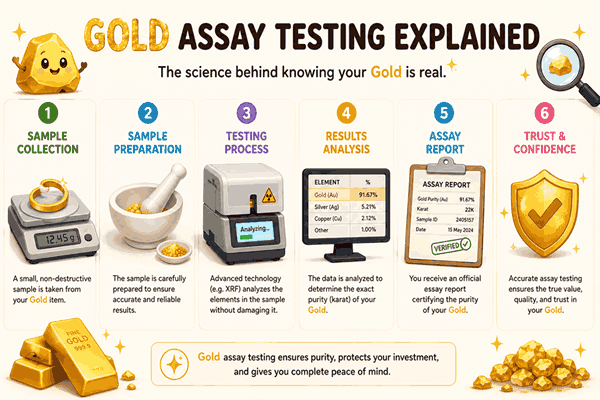
Gold's value comes down to one thing more than anything else: what percentage of it is actually gold. Two bars that look identical and weigh the same can have meaningfully different market values if their purity levels differ — and in a high-value transaction, even a fraction of a percentage point across several kilograms adds up fast. Assay testing is how that question gets answered definitively, with laboratory evidence rather than a seller's assurance.
For anyone involved in buying, selling, exporting, or investing in gold, understanding how assay testing works — what the different methods are, what the results mean, and when each type of test is appropriate — is practical knowledge that protects your investment and helps you ask the right questions before any money moves.
What Gold Assay Testing Actually Is?
An assay is a controlled scientific analysis that measures the exact composition of a gold sample — specifically, what percentage is gold and what the remainder consists of. That remainder might be silver, copper, zinc, platinum, palladium, or other metals depending on the source and how the gold was processed.
Results are expressed as fineness (a decimal figure out of 1000) or as a percentage. Investment-grade refined gold typically comes in at 999.9 fine — meaning 99.99% pure gold with only trace quantities of other elements. Gold doré bars from mining operations are less refined and may contain anywhere from 70% to 95% gold alongside silver and other metals, requiring further processing before they reach investment-grade purity.
The assay process is independent — meaning it's conducted by a qualified laboratory rather than the seller — which is precisely what gives the result its credibility. A seller telling you the purity of their gold is information. A laboratory certificate confirming it is evidence.
Why the Difference Between Stated and Verified Purity Matters?
Consider a transaction involving five kilograms of gold claimed at 99.5% purity. If the actual purity comes back at 97%, the financial difference at current gold prices is significant — easily tens of thousands of dollars on that single transaction. Across larger volumes or repeated purchases, the exposure compounds considerably.
That's the scenario assay testing exists to prevent. For buyers, it confirms they're receiving what they're paying for. For sellers with genuinely high-quality gold, it provides objective documentation that supports their pricing and builds credibility with buyers who might otherwise negotiate based on uncertainty. For export transactions, it satisfies the documentation requirements of customs authorities, banks, and receiving refineries.
The industries that take assay testing most seriously — large refineries, central banks, institutional precious metals buyers — do so because experience has taught them that unverified specifications create disputes, and disputes are expensive.
The Three Main Testing Methods and When Each One Applies
Gold testing isn't a single method — different approaches suit different situations, and understanding the trade-offs helps buyers know what to request and why.
1. Fire Assay Testing
Fire assay is the most accurate gold testing method available and has been the industry benchmark for centuries — it predates modern chemistry and remains the standard against which other methods are measured. The process involves taking a precisely weighed sample, combining it with specific fluxing agents, and heating the mixture to temperatures exceeding 1,000°C. This separates the gold and silver from base metals and impurities. The resulting precious metal bead is then weighed and chemically parted to isolate the gold content.
The precision achieved through fire assay is exceptional — results are typically accurate to within ±0.01% — which is why it's the required method for official certification, London Bullion Market Association (LBMA) standards, and large commercial transactions where high-stakes pricing decisions depend on purity figures. The trade-off is time: fire assay takes longer than other methods and the sample is consumed in the process. For transactions where absolute precision is the priority, that's a worthwhile exchange.
2. X-Ray Fluorescence (XRF) Analysis
XRF testing uses X-ray energy to excite atoms in a sample, causing them to emit secondary X-rays at wavelengths characteristic of each element present. A detector reads those emissions and produces a compositional breakdown — quickly, accurately, and without damaging the sample in any way.
The speed and non-destructive nature of XRF make it the most widely used method for commercial transactions, dealer verification, and export checks. A handheld XRF device can produce results in seconds; a laboratory-grade instrument provides more detailed analysis within minutes. The accuracy is very good for most commercial purposes, though it measures surface composition rather than bulk composition — which means it's susceptible to surface coatings and isn't the appropriate choice where the highest level of precision is required. For initial evaluation, routine verification, and situations where turnaround speed matters, XRF is the practical standard.
3. Chemical (Wet Chemistry) Analysis
Chemical assay involves dissolving a gold sample in acid solutions — typically aqua regia, a mixture of nitric and hydrochloric acid — and then measuring the concentration of gold and other metals in the resulting solution using techniques such as atomic absorption spectroscopy or inductively coupled plasma analysis. This approach can characterize the full elemental composition of a sample in considerable detail, including trace elements present in very small quantities.
Chemical analysis is used when a complete elemental profile is needed — for provenance assessment, when regulatory requirements call for detailed composition records, or when a refinery wants precise data on incoming material to optimize their processing approach.
Reading an Assay Report: What the Numbers Mean
An assay certificate typically includes the sample identification details, the testing method used, the laboratory's accreditation information, the date of analysis, and the composition results. Understanding what the purity figures actually mean in commercial terms helps buyers evaluate what they're acquiring:
- 999.9 fine (99.99%) — Investment-grade refined gold meeting the highest international standard. Required for LBMA Good Delivery bars and most major exchange programs.
- 999 fine (99.9%) — High purity bullion, accepted by most institutional buyers and refineries without further processing.
- 995 fine (99.5%) — The minimum purity threshold for LBMA-acceptable gold and many exchange delivery specifications.
- 900–980 fine — Common range for gold doré bars from mining operations. Commercial value is established, but further refining is required before the gold meets investment-grade specifications.
- Below 900 fine — Gold containing significant quantities of other metals. Processing requirements and pricing will reflect the additional refining needed to bring purity to commercial standards.
The testing methodology noted on the certificate matters as much as the result itself. A purity figure produced by fire assay carries different weight than one produced by XRF — not because XRF is unreliable, but because different buyers and institutions have different acceptance criteria for which method satisfies their requirements.
How Assay Testing Fits Into International Gold Exports
For gold exports, assay documentation isn't optional — it's a standard component of the paperwork package that customs authorities and importing-country regulators expect to see. The assay certificate establishes the declared purity and composition of the shipment, which customs uses to verify the declared value, and which the receiving refinery or buyer uses to confirm that the product matches the purchase agreement.
Banks processing international gold payments frequently request assay certificates as part of their transaction compliance review. Insurance providers covering gold shipments in transit use assay documentation to establish the insured value. Any inconsistency between the assay certificate and other documents in the export package — commercial invoice, packing list, certificate of origin — can flag the shipment for additional inspection and delay.
Getting assay testing done before shipment, using an accredited laboratory and the appropriate methodology for the transaction type, is the most effective way to ensure that documentation holds up at every checkpoint the shipment passes through.
Protecting Yourself as a Buyer
The practical rule for any serious gold buyer is straightforward: don't release funds until you have independent assay documentation in hand. That means a certificate from a laboratory that's independent of the seller, using a methodology appropriate for the transaction, with accreditation credentials you can verify.
Sellers who resist independent testing or become evasive when assay documentation is requested are communicating something important about either their product or their intentions. Legitimate gold with genuinely high purity doesn't need to avoid verification — sellers with clean product typically welcome it because it removes any basis for the buyer to negotiate down on uncertainty grounds.
Requesting assay documentation isn't an unusual demand in professional gold trading. It's the baseline expectation that experienced buyers bring to every transaction, and any supplier worth working with will treat it as standard practice rather than an inconvenience.