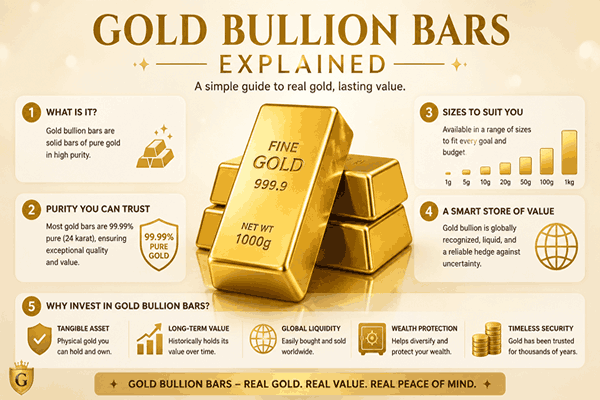
Gold bullion bars have been the preferred vehicle for serious gold ownership for a simple reason: they strip the asset down to its essentials. No fabrication premium for intricate design, no alloy content for durability, no numismatic value that fluctuates independently of the metal itself. A bullion bar is gold, measured and documented, priced on what it actually contains. That transparency is what makes them the instrument of choice for central banks, institutional investors, refineries, and experienced private buyers worldwide.
If you're new to physical gold or considering your first bar purchase, understanding how bullion bars are classified, what the purity standards mean in practice, and how verification works will help you engage with suppliers and make purchasing decisions from a position of knowledge rather than trust alone.
What a Gold Bullion Bar Actually Is
A bullion bar is a refined gold product manufactured to a specific weight and purity standard, produced by a certified refinery and stamped with the information needed to verify it: weight, fineness, refinery name, serial number, and official hallmarks. Those markings aren't decorative — they're the bar's identity documentation, connecting it to a specific production batch that can be traced back to the refinery that produced it.
The key distinction from other gold products is what's not in the bar. Jewelry contains other metals — copper, silver, zinc — added for hardness and workability, and its value reflects design and craftsmanship as much as gold content. Bullion bars contain as close to pure gold as refining allows. Their value tracks spot price directly, which makes them far more straightforward to buy, sell, and price than most other physical gold forms.
The Different Bar Types and What They're Used For
Gold bullion bars come in a wide range of sizes, and the right choice depends on your investment goals, storage situation, and how you expect to eventually sell or transfer the asset.
- Small investment bars (1g–100g): The entry point for retail investors and those building a gold position incrementally. Higher premiums per gram than larger bars, but more flexibility when it comes to selling partial holdings without liquidating an entire position.
- Mid-range bars (250g–1kg): The sweet spot for serious private investors — large enough that premiums per gram are considerably lower than small bars, manageable enough for private vault storage, and liquid enough that most bullion dealers and refineries will purchase them without issue.
- Large commercial bars (several kilograms): Used primarily in institutional and commercial gold trading, where transaction volumes are large and storage is handled professionally. Lower per-gram costs, but less flexible for smaller exit transactions.
- London Good Delivery bars (~400 troy oz / ~12.4kg): The international standard for large-scale gold trading, held by central banks, major financial institutions, and trading houses. They must meet LBMA specifications for weight, purity, dimensions, and hallmarking, and are the benchmark against which most other bars are compared in institutional markets.
Understanding Gold Purity: What the Numbers Mean
Gold purity is expressed as fineness — the parts per thousand that are pure gold. The three most common standards for investment-grade bullion bars are:
- 995 fine (99.5%): The minimum purity threshold for LBMA Good Delivery status. Accepted by most major refineries and institutional buyers without further processing.
- 999 fine (99.9%): The standard for most commercial bullion bars. Widely accepted across international markets and suitable for the majority of investment and trading purposes.
- 999.9 fine (99.99%): The highest standard for investment-grade gold, required by some exchanges and premium buyers. Often referred to as "four nines" gold — the benchmark for the purest commercially available product.
These distinctions matter financially. At current gold prices, the difference in value between a 995 fine kilogram bar and a 999.9 fine kilogram bar is meaningful — and across larger volumes, it becomes significant. Verified purity documentation isn't just paperwork; it's the basis on which pricing is established and value is exchanged.
More detail on how purity is graded and what different fineness levels mean for buyers is available in our Gold Purity Guide and Verification Services pages.
Why Investors Keep Coming Back to Physical Bullion Bars
The case for gold bullion has been made across thousands of years and dozens of economic systems. What makes it compelling today isn't historical precedent alone — it's the specific characteristics that gold bars offer in the context of modern portfolio construction.
Physical gold is one of the few assets that carries no counterparty risk. A stock is a claim on a company. A bond is a claim on a borrower. A currency is a claim on a government's monetary discipline. A gold bar in your vault is a claim on nothing except the metal itself — no institution standing between you and the asset, no platform that can freeze access, no issuer who can default. That independence from the financial system is precisely what makes gold valuable when the financial system is under stress.
Gold also moves differently from equities and fixed income, which is what makes it genuinely useful for diversification rather than just theoretically useful. When equity markets sell off sharply, gold frequently moves in the opposite direction as investors seek safety — providing a counterbalance at exactly the moment other holdings are losing value.
Finally, gold's liquidity is deep and global. Properly verified bullion bars can be sold to refineries, bullion dealers, or institutional buyers in virtually any major market. That exit optionality matters for investors who want an asset they can convert without being at the mercy of a single buyer or a thin local market.
How Bullion Bars Are Verified Before Purchase
Buying a bullion bar means buying a specific claim about its gold content. Verification is how you confirm that claim before funds change hands, not after. The procedures used depend on the transaction type and the level of certainty required:
- Visual inspection and serial number verification against refinery records
- Assay certification review from an accredited laboratory
- XRF analysis for rapid non-destructive composition testing
- Fire assay testing where maximum precision is required
- Weight and dimensional confirmation against stated specifications
- Independent laboratory testing for large-value or dispute-sensitive transactions
A reputable supplier will facilitate this verification rather than resist it. Any reluctance to allow independent testing, or pressure to complete a transaction before verification is done, should be treated as a serious warning sign regardless of how attractive the offer looks.
Storage After Purchase: Getting This Right Matters
The security of a physical gold investment doesn't end at purchase — it depends on how the asset is stored afterward. Options range from home safes for smaller holdings to professionally managed vault facilities for larger positions, and the right choice depends on the size of the investment, insurance requirements, and how frequently you expect to access or move the bars.
Whatever storage method you use, maintain complete records alongside the physical asset: purchase documentation, assay certificates, verification reports, and chain of custody records. Those documents don't just protect you against disputes — they're what make the gold straightforwardly sellable when you eventually want to exit the position. A bar without provenance documentation is harder to sell and commands lower offers than an equivalent bar with a clean paper trail.
Bullion Bars in International Gold Trade
Beyond private investment, gold bullion bars are the primary medium through which refined gold moves through the global supply chain — from mining regions to refineries, from refineries to institutional buyers and central banks, and from trading hubs to manufacturers who use gold in electronics, medical devices, and other industrial applications.
Uganda sits in that chain as a producing country, supplying gold to international markets through exporters who manage the compliance, documentation, and logistics requirements that cross-border gold trade involves. For international buyers sourcing gold from Uganda, working with a supplier who understands both the local regulatory environment and the documentation expectations of destination markets is the most important factor in whether a transaction moves smoothly or not.