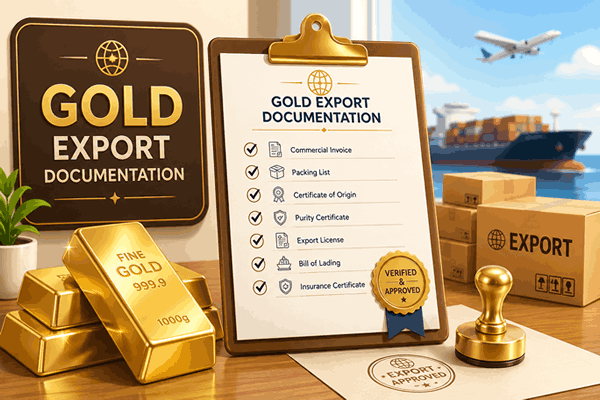
International gold buyers often discover that the documentation side of a transaction is more involved than they expected — and that the consequences of getting it wrong are more serious than a brief delay. A commercial invoice that doesn't align with the customs declaration can hold a shipment for days. An assay certificate that isn't transaction-specific may be rejected by a receiving refinery. An export permit with weight figures that don't match the packing list creates the kind of inconsistency that flags a shipment for additional inspection at exactly the wrong moment.
This guide covers the documentation that international gold exports require, what each document actually does in the transaction, and where problems most commonly arise. Understanding this upfront saves time, money, and the particular frustration of trying to fix paperwork problems once a shipment is already in the logistics chain.
What Export Documentation Is Actually For?
Gold documentation serves the same function across every party that examines it: it's the evidence that confirms a shipment is what it says it is, that it came from where it's claimed to come from, and that it's moving through legitimate channels. Customs authorities on both ends use it to verify declared values and confirm export authorization. Banks processing international payments reference it during compliance screening. Freight and insurance providers use it to establish what they're handling. Refineries and receiving buyers use it to verify specifications before accepting delivery.
When documentation is complete, accurate, and internally consistent — meaning all the documents in the package reference the same weights, purities, and values — every one of those checkpoints processes smoothly. When it isn't, transactions stop until the problem is resolved. The cost of that interruption — in storage fees, demurrage, administrative time, and delayed payment — almost always exceeds the cost of getting the paperwork right in the first place.
The Core Documents: What Each One Does?
1. Commercial Invoice
The commercial invoice is the financial backbone of the transaction. It identifies seller and buyer, describes the product in detail — gold type, fineness, weight — states the agreed price and payment terms, and declares the total transaction value. Customs authorities on both the export and import side use it to assess duties and verify that the declared value matches what's actually being shipped.
Because the commercial invoice is the reference document that other paperwork is checked against, accuracy here is critical. Any figure — weight, purity, value — that differs from what appears on the assay certificate, packing list, or customs declaration creates a discrepancy that gets flagged. These mismatches are almost always the result of documents prepared independently rather than reviewed together, which is why cross-checking the complete package before submission matters.
2. Certificate of Origin
The certificate of origin confirms the country where the gold was produced or processed for export. It's used by customs authorities to determine applicable import regulations, trade agreement eligibility, and sourcing compliance requirements. Different destination countries have specific format and authentication requirements for this document — in some cases requiring notarization or chamber of commerce endorsement — and what satisfies one jurisdiction doesn't automatically satisfy another. Researching destination-specific requirements before the document is prepared avoids having to reissue it under time pressure.
3. Export Permit
The export permit is the Ugandan regulatory authorization that formally approves the gold shipment for departure. It confirms that the transaction has been reviewed by the relevant authority and that all legal requirements on the export side have been met. Without a valid, current export permit, no legitimate gold shipment moves — and a permit with incorrect specifications or expired validity creates the same outcome as no permit at all.
Buyers should always verify that a supplier holds current export authorization and that the permit references the specific transaction before committing funds. A supplier who can't readily produce this documentation is worth treating with significant caution.
4. Assay Certificate
The assay certificate is the laboratory evidence that backs up the purity claims in all other transaction documents. It identifies the gold content, silver content, and trace element composition of the specific batch being exported — produced by an accredited laboratory using recognized testing methodology. For any transaction where purity affects pricing, the assay certificate is the document that converts a seller's stated specification into a verified one.
Two things matter beyond the purity figure itself: that the certificate comes from an accredited, independent laboratory rather than the seller's own testing, and that it references the specific shipment batch rather than being a generic certificate reused across transactions. A refinery that receives gold and conducts its own incoming assay will compare its results against the certificate — discrepancies at that stage create disputes that are considerably harder to resolve than disagreements before shipment.
Our Gold Assay Services and Gold Assay Testing Explained pages cover methodology in more detail.
5. Packing List
The packing list provides the physical details of the shipment — packaging specifications, weight breakdown, dimensions, and item counts. Freight handlers use it to verify what they're receiving. Customs inspectors use it to compare physical contents against declarations. Insurance providers use it to establish the value and nature of what's being covered.
Weight figures on the packing list must match those in the commercial invoice and assay certificate. Even small variations — the result of different measurement points or unit conversions that weren't reconciled — will be noticed by customs and flagged as a discrepancy requiring explanation.
6. Customs Declaration Documents
Export customs declarations and the corresponding import documentation at the destination are the formal records through which the shipment moves through official channels at both ends of the journey. These forms are jurisdiction-specific and need to be completed according to the requirements of each authority — using correct product descriptions, harmonized system codes, and declared values that align with the rest of the documentation package.
7. Insurance Documentation
Transit insurance for high-value gold shipments isn't optional in practice — freight carriers won't accept liability beyond minimal standard amounts, and the gap between that and the actual value of a gold shipment is enormous. Insurance certificates confirm coverage against loss, theft, or damage in transit and are required by some banks and importing authorities as part of the transaction documentation package. The insured value should reflect the verified gold value, not an estimate, which is another reason accurate assay documentation matters before insurance is arranged.
Compliance Records That Increasingly Travel With the Gold
Beyond shipment documents, international gold transactions now routinely require compliance records that demonstrate the transaction's regulatory legitimacy. Banks processing cross-border payments for gold have become significantly more thorough about this, and many will request these records before releasing payment regardless of whether the buyer or seller considers them standard:
- KYC documentation verifying the identity and business standing of both buyer and seller
- AML compliance records demonstrating that source-of-funds and transaction monitoring procedures were followed
- Beneficial ownership information for corporate entities involved in the transaction
- Business registration certificates and tax compliance documents
- Identity verification records supporting the KYC process
These aren't requests that can be fulfilled quickly if they weren't prepared in advance. Our KYC Policy, AML Policy, and Compliance and Due Diligence pages describe how we maintain these records.
Pre-Shipment Verification: Catching Problems Before They Travel
Documentation review and physical verification need to happen together and before anything ships. The checklist that Uganda Bullion works through before authorizing any export:
- Export license confirmed current, valid, and correctly specifying the transaction
- Assay certificate reviewed against the physical product and cross-referenced with declared specifications
- Supplier credentials and licensing verified as current
- Company registration and compliance documentation confirmed
- All documents in the package reviewed together for cross-document consistency
- Logistics arrangements confirmed and aligned with documentation specifications
A discrepancy found during this review takes minutes to resolve. The same discrepancy found at a customs checkpoint or a bank compliance review takes days — and occasionally triggers investigations that take much longer. Additional guidance on evaluating suppliers and avoiding fraud is available on our How to Verify a Gold Seller and How to Avoid Gold Trading Scams pages.
Where Documentation Problems Most Commonly Happen
Most documentation failures in international gold transactions aren't deliberate misrepresentation — they're coordination failures. Documents prepared by different parties without being checked against each other. Standard templates applied to non-standard transaction details. Destination-country requirements assumed rather than confirmed. The most expensive mistakes tend to be the most avoidable ones:
- Weight or value figures that differ across documents because they were prepared at different stages without reconciliation
- Assay certificates that reference a different testing date or batch than the shipment being exported
- Certificates of origin missing authentication steps required by the specific destination country's format
- Export permits with specifications that don't match the commercial invoice
- Customs declarations using product descriptions or codes inconsistent with other documents
- Compliance records from a previous transaction reused without being updated for the current one
Uganda Bullion's Approach to Documentation
We treat documentation as a substantive part of export coordination rather than an administrative task that runs alongside the real work. Our team prepares the complete package — not individual documents in isolation — and reviews everything together for consistency and completeness before submission. Destination-country requirements are confirmed before documents are drafted, not discovered after they've been prepared incorrectly.
Buyers with specific documentation requirements — particular formats their bank expects, fields their importing authority requires, compliance records their legal counsel has requested — should share those at the start of a transaction rather than after documents are complete. The earlier we understand what the receiving end needs, the better we can build the package to satisfy it.
Need Help With Export Documentation?
Tell us your destination country, product type, and any specific requirements your bank, importing authority, or receiving facility has flagged. We'll walk you through exactly what documentation your transaction needs and how we handle each piece.
Contact Uganda Bullion