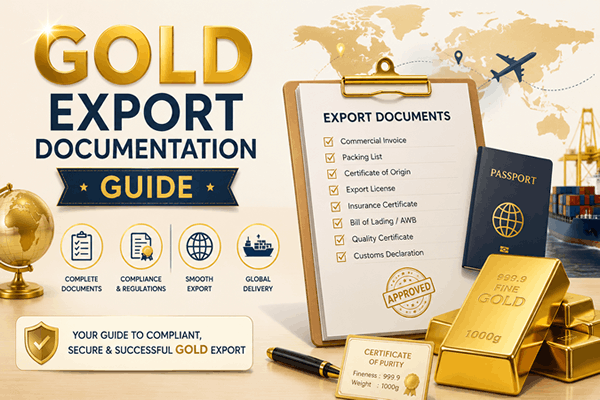
Most international gold transactions that go wrong don't fail because the gold wasn't there or the price wasn't right. They fail because the documentation wasn't. A shipment held at customs because a certificate of origin used the wrong format for the destination country. A bank payment frozen because the commercial invoice didn't include information the correspondent bank's compliance team required. An export permit that referenced a weight figure that didn't match the packing list. Each of these is a preventable problem — and each one is significantly easier to prevent than to fix once a shipment is already in transit.
This guide walks through what gold export documentation actually involves, what each document does, where mistakes most commonly happen, and how to make sure the paperwork behind your transaction holds up at every checkpoint it encounters.
What Export Documentation Is Actually Doing
Gold documentation isn't bureaucratic overhead — it's the evidence layer that every party in an international transaction relies on to confirm that the shipment is legitimate, that the product matches what was agreed, and that the transaction follows the rules. Customs authorities use it to verify declared values and confirm export authorization. Banks use it for AML compliance checks before releasing payments. Freight and insurance providers use it to establish what they're handling and what it's worth. Refineries and receiving facilities use it to confirm product specifications before accepting delivery.
When that evidence is solid — complete, accurate, and internally consistent across every document — transactions move. When it isn't, they stop. And the longer a problem sits unresolved in an international supply chain, the more expensive it gets for everyone involved.
Accurate documentation also does something less immediately obvious: it protects buyers from fraud. A seller who can produce a complete, verified, cross-referenced documentation package is a very different category of counterparty from one who produces only what's specifically requested. The paperwork itself is a credibility signal.
The Core Documents Every Gold Export Needs
Requirements vary by destination country and transaction structure, but the following documents form the foundation of any compliant international gold export from Uganda.
Commercial Invoice
The commercial invoice is the financial record of the transaction — it identifies the seller and buyer, describes the product (gold type, weight, fineness), states the agreed price and payment terms, and declares the shipment value. Customs authorities on both ends use it to assess duties, verify declarations, and confirm that the shipment matches what was agreed commercially.
The commercial invoice has to be accurate and consistent with every other document in the package. Discrepancies between the invoice and the packing list, or between the invoice and the assay certificate, are among the most common triggers for customs holds — and they're entirely avoidable with proper document review before submission.
Certificate of Origin
This document confirms the country where the gold originated and is typically required by importing authorities to verify compliance with sourcing requirements and applicable trade agreements. Different destination countries have different format and authentication requirements for certificates of origin — what satisfies EU customs may not satisfy the same document from a Middle Eastern authority. Understanding destination-specific requirements before the document is prepared is the difference between a certificate that clears and one that gets kicked back.
Export Permit
The export permit is the Ugandan regulatory authorization that allows the shipment to legally leave the country. It confirms that the transaction has been reviewed by the relevant authority and that all legal requirements on the export side have been satisfied. Without a valid export permit, no legitimate shipment moves — and an expired or incorrectly issued permit creates the same problem as no permit at all. This document needs to be applied for early in the transaction process, not assembled at the last minute.
Assay Report
The assay report is the laboratory-produced evidence of the gold's actual purity and composition. It's what turns a stated purity level into a verified one — and the distinction matters financially at any meaningful weight. Assay reports need to come from accredited laboratories using recognized testing methodology, and they need to reference the specific batch being exported. A generic assay certificate not tied to the actual shipment provides much weaker protection than one that's transaction-specific.
More detail on testing methodology and what to look for in an assay report is available on our Gold Assay Services and Quality Assurance and Verification pages.
Packing List
The packing list provides the physical details of the shipment — packaging specifications, dimensions, weight breakdown, and item counts. It's used by freight handlers, customs inspectors, and insurance providers to verify that what's being transported matches what's declared. Weight figures on the packing list need to align precisely with the commercial invoice and the assay report. Any gap — even a small one — creates a discrepancy that will be flagged.
Customs Documentation
Export customs declarations and the corresponding import documentation at the destination are the formal regulatory records that move the shipment through official channels at both ends. These forms vary significantly by country and need to be completed according to the specific requirements of each authority — which is another reason why understanding destination requirements before documentation is prepared matters so much.
Compliance Records That Travel With the Transaction
Beyond the physical shipment documents, international gold transactions increasingly require compliance records that demonstrate the transaction's regulatory legitimacy. Banks processing cross-border gold payments have their own compliance obligations, and they routinely request these records as part of payment processing:
- KYC documentation establishing the verified identity and business standing of both buyer and seller
- AML compliance records demonstrating that source-of-funds and transaction monitoring procedures were followed
- Source verification documents establishing the gold's provenance through the supply chain
- Licensing and certification records confirming the exporter's legal authority to operate
- Transaction correspondence supporting the stated commercial purpose of the deal
Additional detail on our compliance framework is on our AML Compliance, KYC Policy, and Licenses and Certifications pages.
Pre-Shipment Verification That Protects Everyone
Documentation and physical verification need to happen together — one without the other leaves gaps. Before any export is finalized, Uganda Bullion runs a set of checks that confirms the documents match the physical reality of what's being shipped:
- Gold purity confirmed through laboratory assay and cross-referenced with the assay certificate
- Weight verified against the figures declared in the commercial invoice and packing list
- All documentation reviewed as a complete set for internal consistency
- Buyer identity and compliance records confirmed before shipment authorization
- Compliance screening completed against applicable sanctions and AML requirements
- Packaging inspected and confirmed against packing list specifications
This review happens before anything is finalized, not as a formality after commitments are made. Finding a discrepancy at this stage takes minutes to resolve. Finding the same discrepancy at a customs checkpoint takes days — and sometimes triggers investigations that take considerably longer.
The Documentation Mistakes That Create the Most Problems
Most documentation failures aren't intentional — they're the result of documents prepared by different parties without adequate coordination, or standard templates applied to transactions with non-standard details, or requirements researched for one destination country applied incorrectly to another. The most common issues we see:
- Weight or value figures that differ between documents — even by small amounts — because they were prepared independently rather than cross-checked
- Assay certificates that reference a different batch or testing date than the shipment being exported
- Export permits with weight or product specifications that don't match the commercial invoice
- Certificates of origin missing authentication steps required by the destination country's specific format
- Customs declarations that use product descriptions or HS codes inconsistent with the rest of the package
- Expired permits or licenses that weren't caught before submission
- Compliance records prepared for a previous transaction reused without being updated
Every one of these is avoidable. Every one of them is also significantly more disruptive to resolve mid-shipment than to catch during document preparation.
How Uganda Bullion Handles Documentation
We treat documentation as a substantive part of the export process rather than an administrative step that follows the real work. Our team prepares the complete documentation package, reviews every document for accuracy and cross-document consistency, confirms destination-country specific requirements before preparation rather than after, and coordinates between all parties — logistics providers, regulatory authorities, inspection agencies — to ensure that handoffs don't create gaps.
Buyers who have specific documentation requirements — a particular format their bank requires, specific fields their importing authority expects, compliance records their legal team has asked for — should raise those at the start of a conversation rather than after documents have been prepared. The more we know about what the transaction needs to satisfy on the receiving end, the better we can build the documentation package to meet it.
Need Help With Gold Export Documentation?
Tell us about your transaction — destination country, product type, and any specific requirements your bank, importing authority, or receiving refinery has already flagged. We'll walk you through exactly what documentation your shipment will need and how we handle each piece.