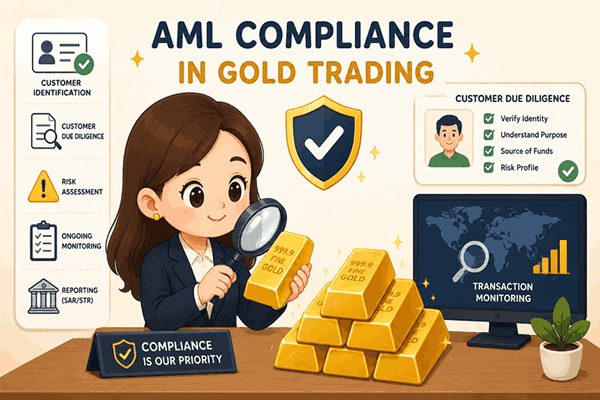
If you've spent any time in the gold trading world, you already know that AML compliance isn't something you can afford to treat as an afterthought. Governments, banks, refineries, and customs authorities across the globe have tightened their expectations significantly — and for good reason. Gold's portability and universal value make it attractive to legitimate investors and bad actors alike, which is exactly why the industry has had to build stronger safeguards.
For buyers and sellers operating legitimately, AML compliance isn't a burden — it's actually one of the clearest signals that you're dealing with people worth trusting. When a supplier can walk you through their due diligence procedures and hand you proper documentation without hesitation, that tells you something important about how they run their business.
What AML Compliance Actually Means
At its core, AML compliance is the set of policies and procedures a business puts in place to detect, prevent, and report suspicious financial activity. In the gold trade specifically, these measures exist to make sure precious metals aren't being used to quietly move or clean money that came from somewhere it shouldn't have.
Gold has always been considered a reliable store of value — and that reputation cuts both ways. The same qualities that make it attractive to investors (high value, compact, universally accepted) also make it a potential vehicle for those looking to shift illicit funds. AML frameworks address that risk directly by requiring transparency at every stage of the supply chain, from the point of origin all the way through to the final buyer.
Why This Matters More Than Most Buyers Realize
A typical international gold transaction touches a surprising number of parties — miners, refiners, exporters, brokers, freight handlers, banks, and the end buyer. Each of those handoffs is a potential weak point if nobody's watching. Without proper compliance procedures woven through the whole chain, the risks compound quickly: document forgery, sanctions violations, inflated invoices, outright fraud.
What AML compliance does, practically speaking, is create a documented trail. It confirms who the parties are, where the money came from, and that the transaction followed the rules — which matters enormously when that shipment reaches a port, a bank processes a wire transfer, or a customs authority wants answers.
For international buyers in particular, this documentation isn't just reassuring — it's often mandatory. Banks increasingly won't touch gold-related payments without it, and import authorities in many countries require supporting compliance records before releasing shipments.
The Building Blocks of a Solid AML Program
Reputable gold suppliers don't just pay lip service to compliance — they build it into how they operate day to day. Here's what that actually looks like in practice:
Customer Due Diligence (CDD)
Before any transaction moves forward, a compliant supplier will verify who they're dealing with. That typically means reviewing passports, company registration documents, proof of address, and beneficial ownership information — not as a formality, but as a genuine check that the person or entity on the other side of the deal is who they say they are.
Know Your Customer (KYC)
KYC goes a step further than basic identity verification. It's about understanding the nature of the relationship, the purpose of the transaction, and whether anything about the picture raises questions. For high-value deals or clients in jurisdictions with elevated risk profiles, enhanced due diligence is standard — more questions, more documentation, more scrutiny.
Source of Funds Verification
One of the most important checks in any gold transaction is confirming that the money being used is clean. This means tracing funds back to a legitimate source — business revenue, investment proceeds, documented savings — rather than taking a buyer's word for it. It's uncomfortable for some people, but it's a non-negotiable part of responsible trading.
Transaction Monitoring
Compliance doesn't stop once a deal is signed. Reputable suppliers monitor transactions on an ongoing basis, watching for unusual patterns — sudden spikes in volume, inconsistent payment methods, mismatched documentation — that might signal something worth investigating. Anything genuinely suspicious gets escalated to the relevant authorities.
Record Keeping
Everything gets documented and retained. Transaction records, identity verification files, compliance checks, correspondence — all of it. Good record keeping isn't just about satisfying auditors; it creates an evidence trail that protects everyone involved if questions arise later.
What International Buyers Should Expect from a Compliant Supplier
If you're importing gold across borders, the compliance standards of your supplier directly affect how smoothly your transaction goes. Banks that handle international precious metals payments have become significantly more cautious — and for buyers dealing with financial institutions that operate under strict regulatory oversight, a supplier who can't produce proper AML documentation is effectively a dead end.
A compliant supplier should be able to provide identity verification records, source documentation, export licenses, assay certificates, and transaction history without making you chase them down. That kind of readiness isn't just professionally reassuring — it actively speeds up banking approvals, customs clearances, and import processing at the other end.
There's also a longer-term benefit worth considering: suppliers who take compliance seriously are the ones that institutions and serious investors keep coming back to. The relationship itself becomes an asset.
What You Actually Gain by Choosing an AML-Compliant Supplier
- Full transaction transparency with a documented paper trail that holds up to scrutiny.
- Significantly lower exposure to fraud, sanctions risk, and financial crime.
- A foundation of genuine trust — not just assurances, but verifiable evidence.
- Banking and payment processes that move without unnecessary friction.
- Confidence that the gold you're acquiring meets international regulatory standards.
- Protection for your own business reputation when importing or reselling.
- A supplier relationship built for the long term, not just a one-off transaction.
In a market where compliance failures can result in seized shipments, frozen accounts, and legal liability, working with a supplier who takes this seriously isn't just the ethical choice — it's the practical one.
How We Approach Compliance at Uganda Bullion
Compliance isn't a department at Uganda Bullion — it's how we operate. Due diligence, accurate record keeping, transparent sourcing, and close coordination with trusted partners throughout the supply chain are built into every transaction we handle. We don't treat AML procedures as boxes to check; we treat them as the foundation that makes legitimate international gold trading possible.
Our clients benefit from that directly. When documentation is thorough and procedures are followed properly from the start, transactions move faster, banking relationships stay intact, and buyers can import with confidence rather than anxiety.
The gold market rewards those who operate with integrity — and penalizes those who cut corners, often in ways that are difficult to recover from. Buyers and sellers who commit to compliance don't just reduce their risk; they position themselves for the kind of long-term, repeat business that actually builds something meaningful.
Have Questions About Our Compliance Process?
We're happy to walk you through our documentation requirements, verification procedures, and how we handle international transactions from start to finish. No vague promises — just straight answers.