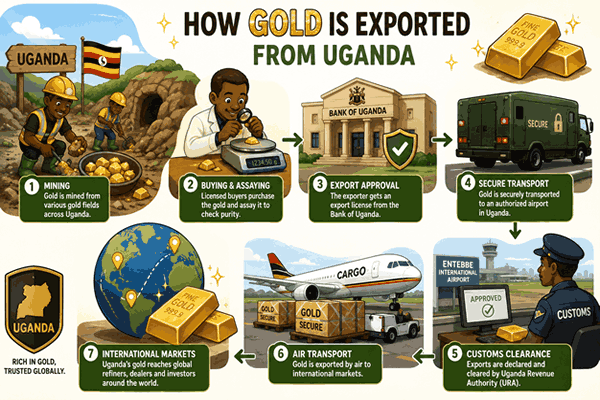
Uganda has grown into one of Africa's most active gold trading and export destinations, drawing in investors, refineries, wholesalers, jewelry manufacturers, and bullion buyers from across the globe. As international demand for precious metals continues to strengthen, understanding how the gold export process actually works in Uganda is essential knowledge for anyone looking to purchase, import, or invest in gold from the region — whether for the first time or as part of an ongoing sourcing strategy.
Exporting gold is a structured, multi-stage process that covers everything from initial sourcing and quality testing through to documentation, compliance verification, customs clearance, and final secure delivery. Reputable exporters follow strict, well-established procedures at every stage to ensure each shipment is fully compliant with both local and international regulations — and that the product arriving at its destination is exactly what was agreed upon.
Gold Sourcing and Procurement
Every export journey begins at the source. Gold is procured from licensed suppliers, mining companies, cooperatives, and authorized dealers — and professional exporters conduct thorough due diligence before any material enters the supply chain. Verifying the origin of the gold and confirming that it meets responsible sourcing standards is not a formality; it is the first line of defence against the risks that poorly documented gold brings with it.
Gold may be acquired in various forms — bullion, bars, dore bars, or dust — depending on availability and buyer requirements. Regardless of form, every product must pass through a verification and quality assessment process before it progresses any further in the export chain. Reliable exporters maintain transparent procurement procedures and work exclusively with legitimate, traceable sources.
Assay Testing and Purity Verification
Before any gold can be exported, it must be professionally assayed. This is the scientific process that determines the exact purity and metallic composition of the material — and it is what gives both buyers and regulatory authorities the documented proof they need to proceed with confidence.
Independent laboratories and accredited assayers use advanced testing methods to verify gold content, and the resulting assay report covers:
- Gold purity percentage
- Weight verification
- Metal composition analysis
- Quality certification details
These results protect both parties in the transaction by ensuring complete transparency about what is being traded. They also feed directly into the export documentation and customs procedures that follow, making accuracy at this stage particularly important.
Compliance and Regulatory Requirements
Gold exports from Uganda operate within a strict regulatory framework, and professional exporters take those obligations seriously. Anti-money laundering (AML) regulations, Know Your Customer (KYC) requirements, and international responsible sourcing standards all apply — and compliance with each of them is non-negotiable.
Compliance procedures typically include:
- Identity verification of buyers
- Business registration checks
- Source-of-funds verification
- Transaction screening and risk assessment
- Export compliance review
These measures are in place to preserve the integrity of the gold trade, reduce financial crime risk, and ensure that every international transaction takes place on solid legal ground. Buyers working with compliant exporters benefit directly from this rigour — it protects them as much as it protects the exporter.
Preparation of Export Documentation
Documentation is one of the most consequential stages of the entire export process. Without complete and accurate paperwork, a shipment simply cannot leave Uganda — and errors or omissions at this stage can cause delays that are both costly and avoidable.
Depending on the transaction, export documentation typically includes:
- Commercial Invoice
- Packing List
- Certificate of Origin
- Assay Certificate
- Export Permit
- Customs Documentation
- Compliance and Verification Reports
- Shipping Documentation
Getting every document right — accurate, complete, and submitted to the correct authority — is what allows customs clearance to proceed smoothly at both the point of departure and the destination country.
Export Licensing and Authorization
Licensed exporters must obtain the relevant approvals before any gold shipment can leave Uganda. Export authorization is the formal confirmation that a shipment has met all required regulatory standards and passed the necessary inspections — and it is what distinguishes a legitimate export from one that will face serious legal complications.
Professional exporters maintain current, valid licenses and certifications as a matter of course. For international buyers, this is one of the clearest indicators of a trustworthy counterpart — and one of the most effective ways to reduce the risks that come with cross-border precious metals transactions.
Secure Packaging and Shipment
Once compliance verification is complete and all documentation has been approved, the gold is prepared for physical transportation. Given the value of what is being moved, security at this stage is absolutely critical.
Shipments are packaged using tamper-resistant methods specifically designed to protect the contents throughout every stage of international transit. Professional exporters work with specialist logistics providers who have direct experience handling high-value commodities — not general freight companies unfamiliar with the unique demands of precious metals transportation.
Every shipment is tracked and actively monitored from departure to delivery, with no gaps in visibility along the way.
Customs Clearance Procedures
Before a shipment can leave Uganda, it must clear customs. Officials review the export documentation, verify the shipment details against the declared content, and confirm that all regulatory requirements have been met. Only once that process is complete can the shipment legally depart.
At the destination, import authorities may carry out their own verification procedures depending on local regulations. Having thorough, well-prepared documentation on both sides of the transaction is what allows this process to move efficiently — and what prevents unnecessary holds or rejections that can disrupt timelines and create significant financial consequences.
International Delivery and Buyer Receipt
With customs requirements satisfied, the shipment proceeds to its destination country. Buyers receive tracking information and regular updates throughout the delivery process, maintaining full visibility until the gold is in their hands.
Upon receipt, buyers typically carry out independent inspections and verification checks to confirm that the shipment matches the agreed specifications in full. Professional exporters remain on hand throughout this stage to provide documentation support and address any questions that arise — because the relationship does not end when the shipment leaves Uganda.
When secure logistics, thorough compliance, and transparent communication all work together, the result is an international gold transaction that both parties can look back on with confidence.
Why Work with a Professional Gold Exporter?
Gold exportation sits at the intersection of legal requirements, logistics complexity, and significant financial stakes. For buyers navigating this landscape without prior experience, the risks of getting something wrong are real — and the consequences can be expensive. Working with an established, professional exporter removes much of that uncertainty.
Experienced exporters bring industry knowledge, verified sourcing networks, robust quality assurance procedures, and proven shipping solutions to every transaction. They guide buyers through documentation requirements, regulatory obligations, purity verification, and international logistics — ensuring that every shipment meets recognised industry standards and arrives without incident.
Key Takeaway
Exporting gold from Uganda is a structured process built on sourcing integrity, accurate assay testing, thorough compliance verification, precise documentation, proper licensing, smooth customs clearance, and secure international delivery. By working with a reputable, experienced exporter, buyers can participate in the global gold market with genuine confidence — protected at every stage by processes designed to keep transactions lawful, transparent, and secure.