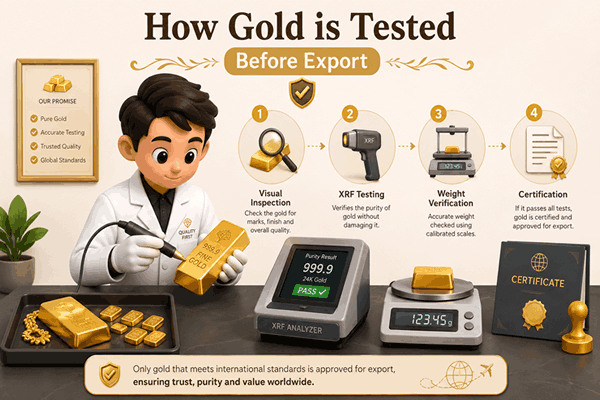
How Gold Is Tested Before Export
Gold testing is one of the most consequential steps in the entire international gold trade — and it is one that reputable exporters take very seriously. Before any shipment leaves Uganda bound for overseas markets, the gold must pass through a series of rigorous verification procedures designed to confirm its authenticity, purity, weight, and overall quality. These tests exist to protect both buyers and sellers, giving everyone involved the assurance that what is being exported genuinely matches the specifications declared in the documentation.
Whether the gold takes the form of bullion bars, dore bars, nuggets, or refined products, professional testing provides the kind of objective confirmation that no verbal assurance can replace. For investors, traders, and international buyers trying to make informed decisions, understanding how gold is tested before export is not just useful background knowledge — it is a fundamental part of buying with confidence.
Why Gold Testing Is Necessary
At its core, gold testing is a quality assurance process — but the stakes it protects against are significant. International buyers need concrete confirmation that the gold they are purchasing contains the stated percentage of pure metal and is free from meaningful impurities or contamination. Without that confirmation, buyers are operating on trust alone, which in high-value international transactions is simply not enough.
Testing also plays an important role in identifying counterfeit materials and guarding against misrepresentation at any point in the supply chain. Beyond commercial necessity, government authorities and regulatory agencies routinely require verified testing results before export permits and customs clearances can be issued. Accurate, documented testing is what keeps the entire chain transparent and gives international clients genuine grounds for trust in their suppliers.
Initial Physical Inspection
The testing process starts with a thorough physical inspection carried out by qualified professionals. This initial stage involves a careful examination of the gold's appearance, shape, consistency, and overall condition — looking for any visible impurities, surface irregularities, or signs that the material has been interfered with.
Gold bars, nuggets, and dore bars are checked for correct markings, expected dimensions, and weight consistency. If anything looks out of place during this inspection, additional testing is triggered before any export approval can be considered. It is a straightforward but important filter that sets the tone for everything that follows.
Accurate Weight Measurement
Following the visual inspection, the gold is weighed on certified precision scales. This step is not administrative — it is fundamental. Because gold value is calculated from a combination of weight and purity, even minor discrepancies in the measured weight can have meaningful consequences for pricing, customs declarations, and regulatory compliance.
Export documentation must reflect the shipment's exact weight with precision. Professional weighing procedures ensure that the quantity of gold a buyer is paying for is the exact quantity that arrives at their door — no more, no less, and no room for ambiguity.
Sampling Procedures
To determine purity, representative samples must be collected from the gold being prepared for export. The quality of this sampling process matters enormously — because the accuracy of every laboratory result that follows depends on whether the sample genuinely and proportionally represents the full shipment.
For dore bars or larger bulk quantities, trained technicians extract samples using approved methods that preserve the integrity of the remaining product. Those samples are then forwarded to the laboratory for assay testing and detailed analysis — the next critical step in establishing what the gold is actually worth.
Gold Assay Testing
Assay testing is widely regarded as the most reliable method for establishing gold purity, and for good reason. An assay measures the precise percentage of pure gold within a sample and identifies exactly which other metals — silver, copper, or trace elements — are present alongside it.
The results give a clear, documented picture of the shipment's commercial value and provide the kind of authoritative purity data that international buyers require before completing transactions. Assay reports are not optional extras — they are a standard and expected part of any legitimate gold export, and buyers are right to insist on them.
XRF Analysis and Modern Technology
Alongside traditional assay methods, many professional laboratories now use X-Ray Fluorescence (XRF) technology as part of their verification toolkit. XRF is a non-destructive testing method — meaning it analyses the elemental composition of a gold sample without causing any damage to the material — and it delivers results quickly and with a high degree of accuracy.
Used in combination with fire assay and other established methods, XRF testing strengthens the overall verification process and provides an additional layer of confidence in the results. The two approaches complement each other well, and together they form a more robust picture of the gold's composition than either method alone.
Purity Verification and Certification
Once all testing is complete, the results are reviewed, documented, and formally recorded. Purity levels are expressed either as a percentage or in karats, depending on the product and the requirements of the buyer or destination market. Export-grade gold typically undergoes strict verification before any certification is issued.
That certification is what gives international buyers documented, verifiable proof that the shipment meets the agreed quality specifications. It travels with the export documentation and serves as supporting evidence during customs clearance and at the point of delivery — a paper trail that protects the buyer's interests long after the gold has left Uganda.
Compliance and Regulatory Checks
Testing for purity is only one part of the pre-export process. Exporters must also satisfy a range of regulatory and compliance requirements before any shipment can be approved for international dispatch. Authorities review ownership records, sourcing documentation, export permits, and supporting paperwork to confirm that the transaction meets all applicable legal standards.
These checks are not obstacles — they are protections. They promote responsible trading practices, reduce the risk of financial crime, and ensure that gold leaving Uganda and entering overseas markets does so legally and with full documentation. Buyers who work with properly compliant exporters benefit from this process directly, experiencing faster clearances and fewer complications at both ends of the transaction.
Final Quality Assurance Review
Before the gold is packaged and handed over to logistics, a final quality assurance review brings everything together. At this stage, all testing results, purity certificates, weight records, and export documents are cross-checked against the shipment details to confirm that everything is consistent and complete.
It is the last safeguard before the gold moves — and for professional exporters, it is a non-negotiable part of the process. Getting this right means the buyer receives exactly what was agreed, the documentation stands up to scrutiny, and the integrity of the transaction is preserved all the way from origin to destination.
Conclusion
Gold testing before export is a comprehensive, multi-stage process — one that spans physical inspection, precision weighing, careful sampling, laboratory assay analysis, purity certification, and full regulatory compliance review. Each stage serves a specific purpose, and together they ensure that international buyers receive products that genuinely match the quality standards and specifications they were promised.
By working with experienced exporters who partner with professional testing facilities and take verification seriously, buyers can engage in the global gold market with real confidence — knowing that every shipment has been thoroughly examined, documented, and approved before it ever leaves Uganda.