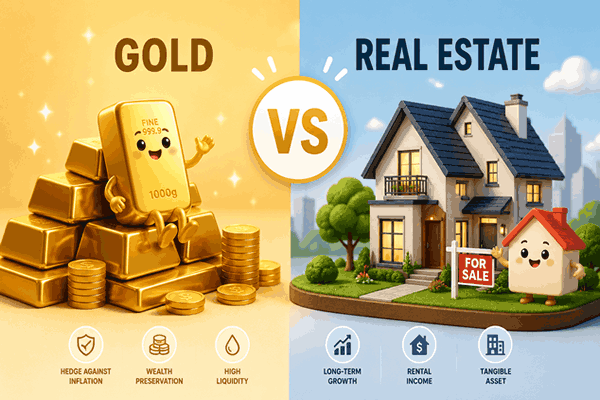
When it comes to building lasting wealth, two assets have consistently stood the test of time above almost everything else: gold and real estate. Generation after generation of investors have turned to both as reliable ways to preserve what they have built, protect against economic uncertainty, and create a foundation of genuine financial security.
That said, choosing between the two is not a straightforward call — and for most serious investors, it does not need to be a choice at all. The right answer depends on your financial goals, how long you plan to hold your investment, how quickly you might need access to your capital, and how much volatility you are comfortable sitting with. Real estate can deliver rental income and long-term capital appreciation, while gold brings portability, high liquidity, and a track record of holding its value when inflation rises and markets wobble.
Understanding Gold as an Investment
Gold's reputation as a store of value stretches back thousands of years — and it has held up remarkably well. Investors buy gold bullion, gold bars, gold nuggets, and other precious metal products to diversify their portfolios and anchor their wealth during periods when economic conditions become unpredictable.
Unlike paper assets, physical gold carries intrinsic value that does not depend on the performance of a company, the decisions of a central bank, or the health of any financial institution. It is globally recognised, traded in markets everywhere, and has a consistent history of performing strongly when currencies weaken or inflation starts climbing. Its portability is another practical advantage — particularly for international investors who value flexibility as much as security.
For many investors, gold is not just another asset class. It is insurance — a hedge against inflation, geopolitical instability, banking system risks, and the kind of sharp equity market downturns that have a habit of arriving without much warning.
Understanding Real Estate as an Investment
Real estate investing covers a broad spectrum — residential properties, commercial buildings, rental units, raw land — but the underlying logic is consistent: you acquire an asset with the expectation that it will generate income, appreciate in value over time, or ideally both.
The ability to earn steady rental income while the property itself grows in value is one of real estate's most compelling qualities. Add the option to use financing leverage — controlling a large asset with a relatively modest upfront commitment — and it becomes clear why property has been the wealth-building vehicle of choice for so many investors over the decades.
That said, real estate ownership is not passive. Maintenance costs, property taxes, insurance premiums, management fees, and the inevitable impact of market cycles all need to be factored in before the picture is complete.
Liquidity: Gold Has a Clear Advantage
If there is one area where gold decisively outperforms real estate, it is liquidity. Physical gold can be sold through reputable dealers, bullion companies, or international markets relatively quickly — in some cases converting to cash within days, depending on market conditions and the size of the holding.
Selling a property is an entirely different experience. Finding the right buyer, conducting inspections, negotiating the price, and working through the legal documentation can stretch the process out over weeks or even months. For investors who find themselves needing capital at short notice, that kind of timeline can create real problems.
For anyone who values financial flexibility and the ability to act quickly when opportunities or emergencies arise, gold's liquidity advantage is a significant one.
Income Generation: Real Estate Leads
When regular income is the priority, real estate has the clear edge. A well-chosen rental property can produce consistent monthly cash flow while the underlying asset quietly appreciates in the background. Commercial properties, depending on occupancy rates and market demand, can push those income returns even higher.
Gold does not generate income. Its value comes from price appreciation and its role as a wealth preservation tool, not from producing cash flow. Investors whose primary goal is to build a stream of passive income will naturally lean toward real estate as the more appropriate vehicle for that objective.
Protection Against Inflation
Both gold and real estate are widely regarded as solid defences against inflation — and both have earned that reputation over time.
Gold has historically maintained its purchasing power through periods of rising prices and currency depreciation. When inflation climbs and the real value of cash savings erodes, gold prices have a strong tendency to rise alongside the cost of living as investors seek the safety of tangible assets.
Real estate can also serve as an inflation hedge, since property values and rental income generally trend upward over the long term. The important caveat is that real estate performance is heavily influenced by local market conditions — what holds true nationally may not reflect the reality of a specific city or neighbourhood.
Gold tends to offer more direct and globally consistent protection against economic uncertainty, while real estate's inflation-hedging qualities are more dependent on where you are invested and what is happening in that particular market.
Initial Investment Requirements
Gold is significantly more accessible to investors who are starting out or working with limited capital. You can begin with a modest purchase and build your holdings gradually over time without needing to commit a large sum upfront.
Real estate carries a much higher barrier to entry. Down payments, legal fees, stamp duties, ongoing maintenance costs, and financing expenses can make the initial outlay substantial — and that is before the first tenant has moved in or the first rental cheque has arrived.
For first-time investors looking to gain exposure to a tangible, inflation-resistant asset without overextending themselves financially, gold offers a far more manageable starting point.
Risk Factors to Consider
No investment is without risk, and both gold and real estate have their own set of vulnerabilities worth understanding clearly before committing capital.
Gold prices respond to a wide range of external forces — global demand, interest rate movements, economic conditions, geopolitical events, and currency fluctuations. That said, gold has demonstrated a consistent ability to hold its ground and recover during financial crises, which is precisely why it attracts investors when broader markets are under stress.
Real estate risks include property market downturns, extended vacancy periods, unexpected maintenance costs, changing regulations, and the very localised economic factors that can make one street a great investment and the next one a poor choice. Location remains everything in property — and getting it wrong is an expensive lesson.
The most effective way to manage these risks is diversification. Many experienced investors hold both gold and real estate rather than concentrating everything in a single asset class, and for good reason.
Portfolio Diversification Benefits
The principle of diversification exists because different assets respond differently to the same economic conditions — and that difference is genuinely protective when markets move against you.
Gold frequently moves in the opposite direction to equities and property markets, which makes it a particularly effective diversification tool. During periods when real estate values are under pressure or stock markets are selling off, gold has historically helped cushion the impact and balance overall portfolio performance.
A strategy that combines physical gold with real estate exposure gives investors a more resilient foundation — one that is better equipped to weather a wider range of economic scenarios while still pursuing long-term growth.
Which Investment Is Better?
The honest answer is that it depends entirely on what you are trying to achieve:
- Choose gold if: You value liquidity, wealth preservation, portability, and protection against economic uncertainty.
- Choose real estate if: You seek rental income, leverage opportunities, and long-term property appreciation.
- Choose both if: You want diversification and balanced exposure to multiple tangible asset classes.
The most successful investors rarely frame this as an either-or question. Gold and real estate serve different functions within a portfolio — one protects wealth and preserves flexibility, the other generates income and grows capital over the long term. Together, they complement each other in ways that neither can fully achieve alone.
Final Thoughts
Gold and real estate have both proven their worth as long-term investment assets across dramatically different economic environments, and neither is universally superior to the other. Each brings a distinct set of strengths, and the right balance depends on the individual investor's goals, timeline, and financial situation.
For investors who prioritise a secure store of value, strong liquidity, and reliable protection against market uncertainty, physical gold makes a compelling case for itself. For those focused on generating income and building capital through property ownership, real estate offers qualities that gold simply cannot match. And for investors who want the best of both worlds — a well-balanced portfolio often delivers exactly that.
Explore More Gold Resources
Discover more about gold investing, bullion products, verification processes, and international gold trading opportunities through Uganda Bullion's trusted resources.