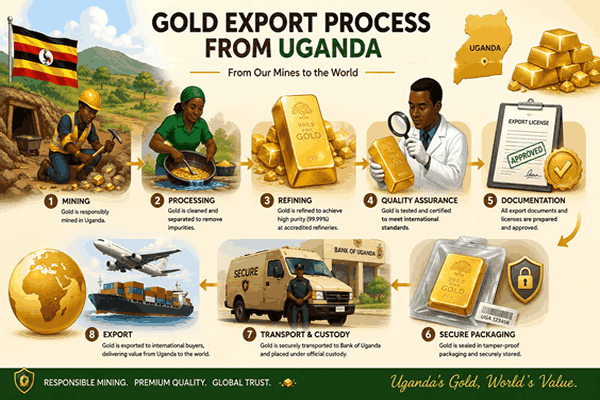
Buying gold from Uganda and getting it to an international destination involves more steps than most first-time buyers anticipate — and the sequence those steps happen in matters as much as the steps themselves. Compliance verification done after a purchase agreement is signed creates complications that could have been avoided. Documentation assembled in the wrong order creates inconsistencies that customs and banking authorities flag. Logistics arranged before export approval is confirmed wastes time and occasionally money.
This guide walks through the full export process in the sequence it actually needs to happen, explaining what each stage involves, why it matters, and what can go wrong if it's handled carelessly. Whether you're purchasing for the first time from Uganda or looking to understand the process more thoroughly before your next transaction, understanding the full picture upfront is what separates smooth transactions from problematic ones.
Step 1: Supplier Verification — Before Anything Else
The first step isn't choosing a product or negotiating a price. It's establishing that the supplier you're considering is who they claim to be and that they're legally authorized to do what they're offering to do.
That means reviewing company registration documentation against official sources, confirming that export licenses are current and not simply claimed, checking compliance records and trading history, and assessing how the supplier communicates — specifically whether they answer detailed questions directly or deflect when specifics are requested. A supplier who welcomes scrutiny and provides verification documentation readily is telling you something positive about how they operate. One who creates urgency around commitment before due diligence is complete is telling you something equally important.
At Uganda Bullion, we provide full company documentation and encourage buyers to conduct independent verification before proceeding. That's not an unusual request in professional gold trading — it's the baseline.
Step 2: Product Specification and Availability Confirmation
Once a supplier's credentials are established, the conversation moves to the specific product. Gold type, purity specification, weight or volume, available timing, and any particular requirements the buyer's downstream partners — their refinery, their bank, their importing authority — have already flagged. This is the stage where realistic expectations get set on both sides, and where mismatches between what a buyer needs and what a supplier can actually provide become apparent before a contract is signed rather than after.
Pricing is also discussed at this stage, but it follows from specification rather than leading it. A price quoted before product specifications are confirmed isn't a reliable price — it's a figure designed to attract attention.
Step 3: Gold Assay and Independent Verification
Before any purchase commitment is made, the gold needs to be tested. Assaying determines the actual purity and composition of the product — the percentage of gold, the silver content, and the presence of other trace metals. The result determines accurate pricing and produces the assay certificate that travels with the shipment through every downstream checkpoint.
Two things matter beyond the purity figure itself: the independence of the testing and the specificity of the certificate. An assay conducted by an accredited laboratory independent of the seller carries significantly more weight than one produced by the seller's own facilities. A certificate tied to the specific batch being exported is considerably more useful than a generic credential. Buyers whose receiving refineries conduct incoming assay on arrival will compare their results against the export certificate — starting with accurate, independent testing prevents the discrepancies that create disputes.
Uganda Bullion facilitates independent testing and structures transactions so verification can be completed before any financial commitment is required.
Step 4: Commercial Agreement and Contract
Once product specifications are confirmed and assay results are in hand, both parties can negotiate and formalize a purchase agreement. The contract should specify quantity, confirmed purity and composition, pricing methodology tied to verified gold content, payment terms and timing, delivery arrangements, inspection rights, and what happens if specifications aren't met on delivery.
A well-drafted agreement protects both sides by removing ambiguity about what was agreed. It also forms part of the documentation package that banks and compliance authorities will examine when processing the transaction. Vague or incomplete contracts create problems not just between buyer and seller but with the third parties whose approval the transaction requires.
Step 5: Buyer Verification and KYC Procedures
This step surprises some buyers — but it shouldn't. Every legitimate gold transaction requires Know Your Customer verification on the buyer side, and the requirements have become more thorough as banks and regulatory authorities have tightened their oversight of international precious metals payments. Buyers should expect to provide company registration documents, identification records, proof of business activity, source-of-funds documentation, and beneficial ownership information for corporate entities.
Providing this documentation completely and accurately isn't just a compliance formality — it's what allows the transaction to pass bank compliance screening when payment is processed and export approval is sought. Buyers who resist or delay KYC create bottlenecks that slow down their own transactions. Those who have their documentation prepared in advance move through this stage quickly.
Step 6: Export Documentation Preparation
With the commercial agreement signed and KYC complete, the full export documentation package is prepared. This is where careful attention to detail prevents the most common and costly transaction problems. Every document in the package needs to be accurate and consistent with every other document — weight figures, purity specifications, and declared values must match across the commercial invoice, assay certificate, packing list, export permit, and customs declaration.
The standard export documentation package for Uganda gold includes:
- Commercial invoice with complete transaction details and accurate declared value
- Export permit issued by the relevant Ugandan regulatory authority
- Certificate of origin meeting the specific format requirements of the destination country
- Assay report from an accredited laboratory tied to the specific shipment
- Packing list with physical details that match the commercial invoice exactly
- Customs declaration documentation for both export and import clearance
- Airway bill or shipping documentation from the logistics provider
- AML and KYC compliance records required by banks and importing authorities
Uganda Bullion reviews the complete package as a set before submission — because a discrepancy found during review takes minutes to correct, while the same discrepancy found at a customs checkpoint takes days.
Step 7: Regulatory Compliance and Export Approval
Uganda's gold export regulatory framework requires formal approval before any shipment departs. The relevant authorities review the transaction, examine licensing and compliance documentation, and issue the export permit that authorizes the shipment. This process takes time — which is why it needs to be initiated early in the transaction rather than treated as a final step.
Exporters who understand the regulatory process know what documentation each authority requires, what the realistic approval timelines look like, and how to handle queries or requests for additional information without creating delays. Buyers working with inexperienced exporters often discover that regulatory approval takes far longer than expected because the application wasn't properly prepared.
Step 8: Secure Packaging and Logistics Coordination
Once export authorization is confirmed, the gold is packaged for transportation. Precious metals shipments require significantly more careful handling than standard cargo — proper containment to prevent weight loss in transit, tamper-evident packaging that confirms the shipment hasn't been accessed between origin and destination, and security arrangements appropriate for the value being moved.
Uganda Bullion coordinates with logistics partners who specialize in precious metals transportation rather than general freight carriers. That distinction matters for packaging standards, security protocols, insurance coverage, and the chain-of-custody documentation that confirms who handled the shipment at every stage of transit.
Step 9: International Shipping and Customs Clearance
The shipment departs Uganda with a complete documentation package and tracking arrangements in place. Ugandan customs authorities process the export documentation and confirm clearance. The shipment moves through transit points to the destination country, where importing authorities examine the documentation, verify compliance with local regulations, and may conduct physical inspection of the shipment.
Buyers are kept informed throughout this stage — not just at departure and arrival, but at intermediate points where something requires attention. An experienced export team anticipates the questions that customs authorities at specific destinations tend to ask and prepares documentation accordingly rather than responding to requests reactively.
Step 10: Delivery Confirmation and Post-Transaction Support
The transaction completes when the shipment reaches the buyer and all contractual specifications are confirmed as met. Delivery documentation, weight and purity confirmation at the receiving end, and final compliance records complete the transaction file. For buyers whose receiving refinery or institution conducts incoming verification, the assay results at their end should align with the export documentation — and with a properly tested, correctly documented shipment, they will.
Uganda Bullion remains available after delivery for documentation support, queries from banks or compliance authorities, and any follow-up requirements that arise from the transaction. The relationship continues beyond the shipment.
Why the Process Matters as Much as the Product
International gold buyers have many supplier options. What distinguishes a supplier worth working with over time isn't just the quality of the gold — it's how reliably they execute the full process around it. Documentation that holds up at every checkpoint. Compliance procedures that satisfy bank scrutiny. Logistics coordination that protects the cargo. Communication that keeps buyers informed throughout rather than going quiet between stages.
That's the standard Uganda Bullion holds itself to, and it's the standard buyers should apply when evaluating any gold export partner.
Need Assistance with Gold Exports from Uganda?
Tell us where you are in the process — whether you're evaluating Uganda as a sourcing market for the first time or working through a specific transaction — and we'll give you direct, practical guidance on what the next steps look like and what we can do to support them.