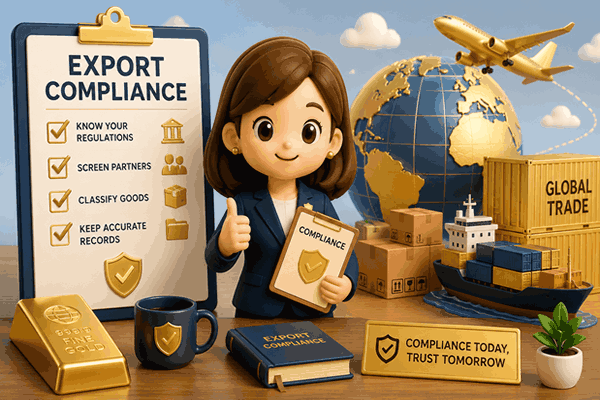
Ask any experienced international gold buyer what separates a smooth transaction from a frustrating one, and the answer almost always comes back to compliance. Not pricing. Not even product quality — though both matter. It's the documentation, the verification procedures, and the regulatory groundwork that determine whether a shipment clears customs cleanly, whether a bank releases a payment without a hold, and whether the whole process moves at a professional pace or grinds to a halt waiting for paperwork that should have been prepared weeks earlier.
Uganda Bullion was built around the understanding that export compliance isn't a separate function from gold trading — it's woven into every stage of it. From the moment a buyer makes an initial inquiry through to final delivery confirmation, our process is designed to keep compliance current rather than catching up to it.
What Export Compliance Actually Involves
Export compliance is the process of ensuring that gold moves across international borders legally, transparently, and in full alignment with the regulatory requirements of both the exporting and importing countries. It's not a single step or a single document — it's a sequence of procedures that have to be executed correctly and in the right order.
For gold specifically, those procedures typically cover product verification and quality confirmation, export authorization from the relevant Ugandan regulatory authorities, documentation preparation, buyer and seller identification requirements, customs procedures at the point of export, and adherence to the import regulations of the destination country. Miss any one of those, and you've created a problem that's usually harder to fix mid-shipment than it would have been to prevent at the start.
Why Getting This Right Matters More Than Most Buyers Realize
The consequences of poor export compliance don't announce themselves in advance — they surface at the worst possible moment. A shipment held at a port. A bank payment frozen pending additional documentation. A customs authority requesting records that were never prepared. An importer facing regulatory scrutiny because the supplier's paperwork didn't meet the destination country's standards.
Buyers who work with compliance-focused exporters avoid most of these scenarios because the preparation happens before the shipment moves, not in response to a problem after it's already in transit. The practical benefits include:
- Customs clearance that moves efficiently because documentation is complete and accurate from the start.
- Reduced shipment delays caused by missing or inconsistent paperwork.
- Protection against fraud — proper verification procedures catch problems before funds are committed.
- Banking and payment processes that proceed without holds or compliance flags.
- A clear paper trail demonstrating legal sourcing that satisfies regulators, refineries, and importing authorities.
- Confidence for investors and institutional partners who have their own compliance requirements to satisfy.
- Alignment with international trade standards that increasingly gate access to reputable buyers and financial institutions.
In short — compliance handled properly upfront creates transactions that close cleanly. Compliance handled poorly creates problems that compound.
The Documentation That International Gold Transactions Require
Documentation is where most compliance breakdowns actually happen. Not because exporters don't know what's needed, but because preparing complete, accurate, and consistent documentation across a set of interconnected records takes discipline and experience. A discrepancy between a commercial invoice and a packing list, or a certificate of origin that doesn't align with the declared weight, can hold up a shipment for days.
For a typical international gold export from Uganda, the documentation package may include:
- Commercial invoices with complete transaction details and accurate product descriptions.
- Export permits issued by the relevant Ugandan regulatory authority.
- Packing lists that match the physical shipment precisely.
- Certificates of origin confirming the gold's provenance.
- Quality verification and assay reports establishing purity and composition.
- Shipping and freight documentation from the logistics provider.
- Customs declarations prepared to the specification of both export and import authorities.
- Buyer and seller verification records supporting the transaction's AML and KYC compliance.
Uganda Bullion prepares this documentation as a standard part of every transaction rather than assembling it on request. When buyers or their banks need specific records, they're available — not in process of being located.
Verification and Due Diligence Before Anything Ships
Documentation describes a transaction. Verification confirms it. Both are necessary, and neither substitutes for the other.
Before any export moves forward, Uganda Bullion runs verification procedures that cover the legitimacy of the transaction, the identity and business standing of the buyer, and the compliance status of everyone involved in the supply chain. This includes identity verification against provided documentation, company registration confirmation, transaction purpose assessment, and a review of any factors that would indicate elevated compliance risk.
Buyers who have completed this process with us — and who have their own documentation in order — typically find that subsequent transactions move considerably faster. The foundational due diligence is already done; we're building on an established and verified relationship rather than starting from scratch each time.
Keeping Pace with Evolving International Standards
The regulatory environment around international gold trade has tightened consistently over the past decade, and that trend isn't reversing. Financial institutions are more cautious about processing precious metals payments. Importing countries have strengthened their provenance and sourcing requirements. Refineries increasingly demand chain-of-custody documentation that would have been considered unusually detailed a few years ago.
Exporters who haven't kept pace with these developments create problems for their buyers — even when the gold itself is legitimate and the transaction is entirely proper. Uganda Bullion actively tracks regulatory developments in our key export markets and adjusts our documentation and compliance procedures accordingly. Buyers shouldn't have to manage the gap between their supplier's practices and what's currently expected — that's our job.
Product Verification as Part of the Export Process
A buyer agreeing to purchase gold of a specific purity and weight is only as protected as the verification process behind those specifications. Stated purity is not verified purity. Uganda Bullion incorporates product verification — including assay reports, inspection procedures, and quality assessments — into our export process rather than treating it as a separate buyer responsibility.
The documentation we provide reflects what the product actually is, confirmed through appropriate testing and inspection, not what a seller claims it to be. For buyers whose downstream partners — refineries, institutional buyers, importing authorities — will conduct their own verification on receipt, starting with accurate documentation prevents the kind of discrepancies that complicate delivery and damage supplier relationships.
Logistics That Match the Value of What's Being Moved
Secure logistics for precious metals require considerably more planning than standard freight. Packaging standards, security arrangements, insurance coverage, carrier selection, and customs coordination all have to be calibrated to the value and sensitivity of the cargo. An approach that works fine for industrial goods can expose high-value gold shipments to unnecessary risk.
Uganda Bullion works with logistics partners who specialize in precious metals movement and understand the specific requirements involved. That means shipments are handled with appropriate security from packaging through delivery, and compliance requirements along the route are anticipated rather than discovered at a checkpoint. Buyers are kept informed throughout the process — not because we have to provide updates, but because transparency during transit is part of what a professional export service looks like.
What Consistent Compliance Builds Over Time
The most valuable thing a compliant exporter creates for long-term buyers isn't any single documentation package or verified shipment — it's a track record. Banks get more comfortable processing transactions when they can see a history of clean, well-documented gold purchases. Customs authorities process shipments faster when a supplier has an established record of accurate declarations. Refineries accept product more readily when they've seen consistent quality verification from the same source.
That track record takes time to build and is surprisingly easy to damage with a single poorly handled transaction. Uganda Bullion approaches every export with the understanding that our reputation — and our buyers' experience — depends on getting each transaction right, not just most of them.
Working with Uganda Bullion on Export Compliance
Our export compliance support covers the full transaction cycle — from initial documentation guidance and verification procedures through shipment coordination and delivery confirmation. Buyers who are new to importing gold from Uganda get guidance on what to expect at each stage and what their own banks, importing authorities, and legal advisors are likely to require. Buyers with established processes get a supplier whose documentation integrates cleanly with their existing compliance framework.
If you have specific export compliance questions — about documentation requirements for your destination country, about our verification procedures, or about how we handle particular transaction types — we'd rather answer them directly than point you to a general overview. Get in touch and tell us what you're working with.
Need Export Compliance Support?
Talk to Uganda Bullion about documentation requirements, verification procedures, regulatory standards, and how we handle international gold transactions from start to finish. Specific questions get specific answers.